The Vía Serrana is a 240km Camino de Santiago route beginning in La Línea (the Spanish town adjacent to Gibraltar) and ending in Sevilla. It takes in many of the highlights you would expect to find in Andalucía, from historic cities to whitewashed towns and Mediterranean landscapes dominated by olive groves.
For me, the Vía Serrana was ultimately not marked by any of these things, however, but instead by an emotional phone call from half a world away that became the indelible memory of this camino.
This is my day-by-day diary from the Vía Serrana.

Vía Serrana Day 1 — La Línea to San Martín del Tesorillo: ~27km
A pre-dawn departure for my first day on the Vía Serrana, but that’s not saying much when sunrise is at 8:11am. I leave about half an hour before then under clear skies and, after my dalliance with Tau waymarking signs on the Via di Francesco last month, I’m back to following yellow arrows again.
The highlight of the stage comes early on, as long as you remember to turn around from time to time. After leaving La Línea, there are great views back to the Rock of Gibraltar silhouetted in the early morning light — and beyond to coastline of Africa.

Looking forward again, it’s mostly dry, parched scrubland for 8km to San Roque, the only town during the stage and the first of what I assume will be many almost blindingly whitewashed settlements on this camino.
After San Roque, it’s about 19km of rural walking where you see barely a soul, save the odd donkey or goat. The vegetation ranges from outrageously colourful orange flowers set against the deep blue sky, to the much more common — and poignant — dead thistles that dominate the late November landscape. The walk is mostly shadeless but a pine forest or two offers the chance for a picnic lunch out of the sun.
San Martín isn’t anything special but it’s not a bad spot to watch local life go by in a nondescript place, as the guide books would say. In the late afternoon I see two men sitting at an outdoor café in the centre of town holding the reins of their two horses who are just hanging out on the street, and I think to myself: this is going to be an interesting camino.
Vía Serrana Day 2 — San Martín del Tesorillo to Jimena de la Frontera: ~18km
The initial part of today’s stage is through a wind turbine park, which takes me back to my first trip to Spain in 2001, when I saw wind turbines for the first time.
But not this close. To walk right next to them today, to see how they tower above you and to hear the woosh of the blades slicing through the air — well, it’s quite impressive. Now that many European countries are facing energy shortfalls this winter, I wonder how many people’s first impression of wind turbines is still that they are a blot on the landscape?
The rest of the stage is short and sunny, if unremarkable. It’s slightly greener than yesterday, with more shrubs and almost no dead thistles. By noon, I’ve already arrived at my destination.
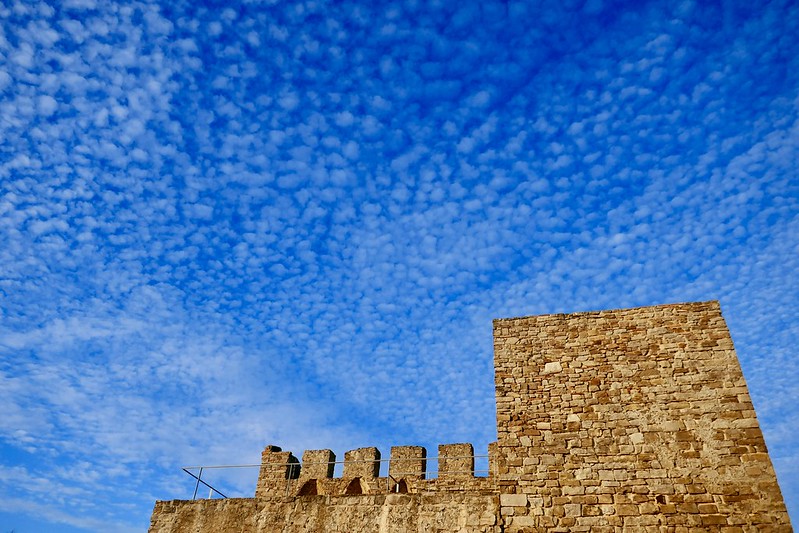
Jimena de la Frontera is the first historic town of this camino, and it’s to visit places like this that I’m here in the first place. The whitewashed town shimmers on a hillside, topped by a medieval castle that rises high above the tiled rooftops and almost blends into the arid landscape that surrounds it. As I stop at a restaurant in town, the first song playing is ‘Walk of Life’ by Dire Straits, which makes me smile.
I eat a tajine for lunch and then explore the Islamic elements of the castle, with goats roaming around the fortifications. If I squint, this could almost be Morocco.
Vía Serrana Day 3 — Jimena de la Frontera to El Colmenar: ~19km
Rain.
It rained through the night and it’s pouring when I wake up this morning. I’m more anxious about walking in the rain than I should be, but that’s because up to now I have somehow walked 70 days on camino in 2022 without needing to wear my poncho once while on the trail. Including in Galicia.
I wait until sunrise, and then a bit longer, and soon the rain eases off and becomes just a drizzle — almost light enough to not require a poncho, but not quite. I put it on and set off, and the rain is pretty light to begin with and gets lighter before stopping for good in the late morning, so it‘s not that bad after all. The camino is a mixture of asphalt roads and dirt paths, and the former is actually better because the latter involves mud, and therefore mud-caking.
It’s foggy even when the rain stops, so there’s not much visibility. After San Pablo de Buceite, the trail passes avocado plantations and then climbs into the hills for what I suspect would be, on a clear day, the best scenery on the Vía Serrana since the Rock of Gibraltar disappeared from view. Even without views, and despite the mud, it’s nice walking. As I approach El Colmenar, the visibility is better and I can see some of the rock face of the Cañón de las Buitreras — which awaits tomorrow — in the distance.
The forecast called for more rain tomorrow, but it changes seemingly by the hour and now it looks like it might even be sunny. So I’ll take a day like today and even one or two more if the trade-off is a sunny day through the canyon.
Vía Serrana Day 4 — El Colmenar to Jimera de Líber: ~26km.
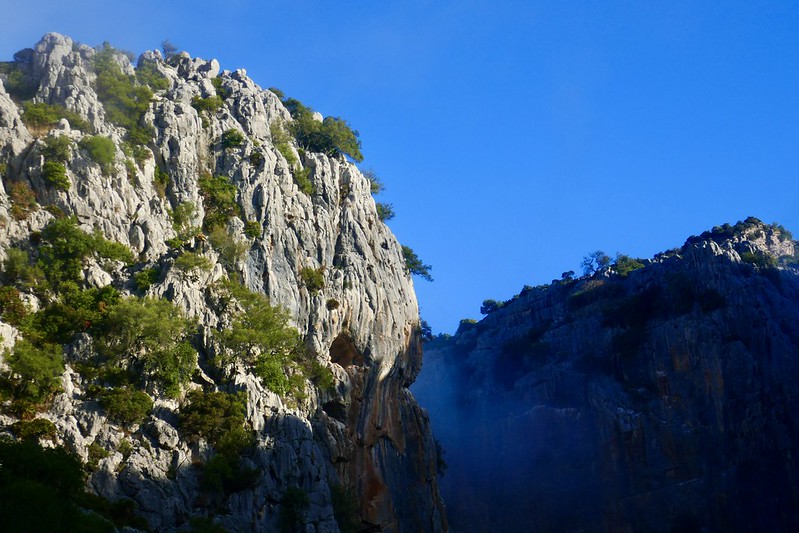
Gently sloping, forested hills are quickly transformed into sheer, dramatic cliffs. Early morning beams of sunlight pierce the crags only to vanish into the vast expanse of the valley floor far below. Birds of prey soar high above, ominously circling at first, then making majestic sorties from the mountaintop. Defying the sunshine and blue sky, fog rolls through the narrowest stretch of the gorge, infusing magic and mystique into the landscape. The thunderous rapids of a fast-flowing river provide the only soundtrack. It’s utterly spectacular, and no one else is here.
It’s the Canyon of the Vultures.
Vía Serrana Day 5 — Jimera de Líber to Ronda: ~19km
It’s foggy when I leave Jimera in the dark this morning but I don’t mind, as I know a nice day is out there somewhere, and the trail is a joy to walk on. It’s a path cut into the mountainside, wide and mud-free. I come across a herd of sheep on the path, and they take one look at me and scatter, dashing up the mountain.
By the time I reach Estación de Benaojan, the fog starts to lift, the sky turns blue and the surrounding landscape is revealed for the first time: olive trees and golden wheat fields framed by mountains, or, in other words, the Andalucían countryside that I’m here for. The next section of the walk is hilly but beautiful, and the first, distant glimpse of Ronda — a city built on cliffs — is breathtaking.
It’s the first time I’ve been to Ronda and the city is extraordinary: medieval gates and walls, whitewashed buildings, soaring church towers, Islamic remains and, most famously, a dramatic gorge that somehow runs right through the centre of the city. There are blue skies above when I arrive and, later, spectacular storm light as dark grey clouds roll in.
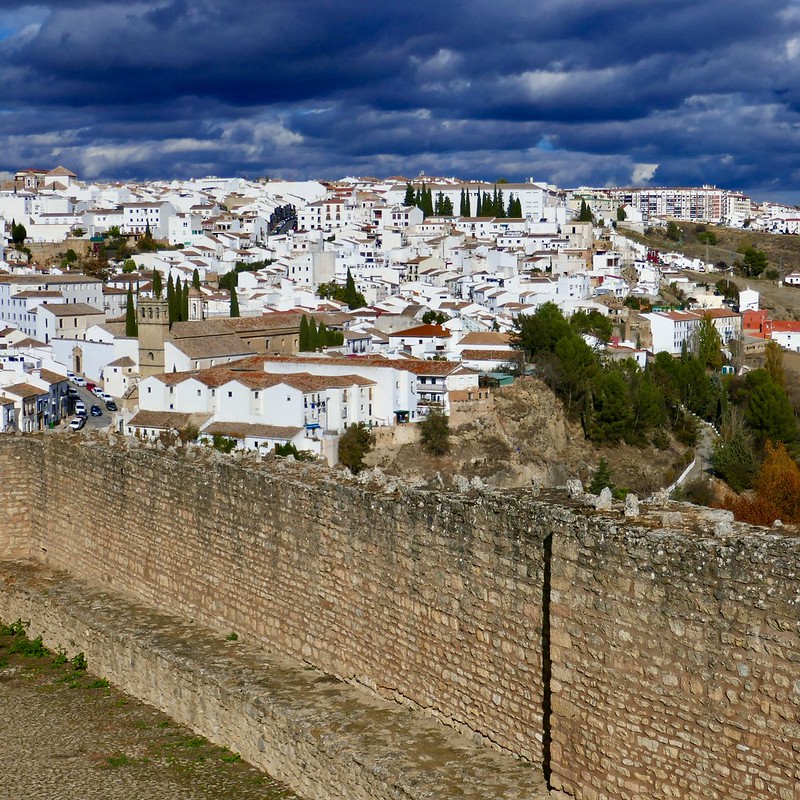
Overall, this is the best day on the Vía Serrana so far. The trails are great for walking, the scenery is gorgeous (despite not reaching the heights of yesterday’s canyon) and Ronda is a special place to end the stage.
Ronda also marks the halfway point of this camino. After the fabulous last couple of days, what else does the Vía Serrana have in store for me?
Vía Serrana Day 6 — Ronda to Olvera: ~33km (including detour)
I would have gladly stayed an extra day in Ronda but I don’t have time and instead leave under the cover of darkness this morning. The weather is either hazy (according to my weather app) or raining (according to what it actually is when I step outside). But it’s very light rain and in any case it stops in a few minutes, giving way to the morning fog which has become common in the last few days.
After some asphalt road walking to begin the stage, the camino soon evolves into pleasant dirt paths through the countryside and the sun peeks out every now and then. I see olive groves on a mass scale for the first time on this camino — those distinct green leaves set against a stormy grey sky — and an occasional late autumn vineyard in yellows and reds.
Towards lunchtime I make a detour to the archeological site at Acinipo, which adds about 5-6km to my day. Fortunately, it’s worth it for the 1st-century BC Roman Theatre, which retains an impressive stage backing in addition to seating carved out of the rock. Because of their engineering capacity and eventual mastery of concrete, the Romans didn’t need to build their theatres into hills the way the Greeks did, but they did in this case and seeing it is the highlight of the stage.

Soon after leaving the theatre I get my first tantalising glimpse of Olvera – whitewashed, dramatically set on a hillside, surrounded by olive groves … and 15km away. Reaching it is a slog, often on paved roads and under an overcast sky, and I arrive with only half an hour of daylight left. When I get there, light drizzle is falling again, the bookends of my day.
Vía Serrana Day 7 — Olvera to Coripe: ~24km
Five minutes after setting out in the dark this morning, I receive a teary phone call from home with news of a serious medical diagnosis in my family*. A few minutes later, shaken and trying to process what I’ve heard, I turn around to see the sky lit up and I take this photo, because what else can I do? Besides, one sunrise represents the promise of many more to come.
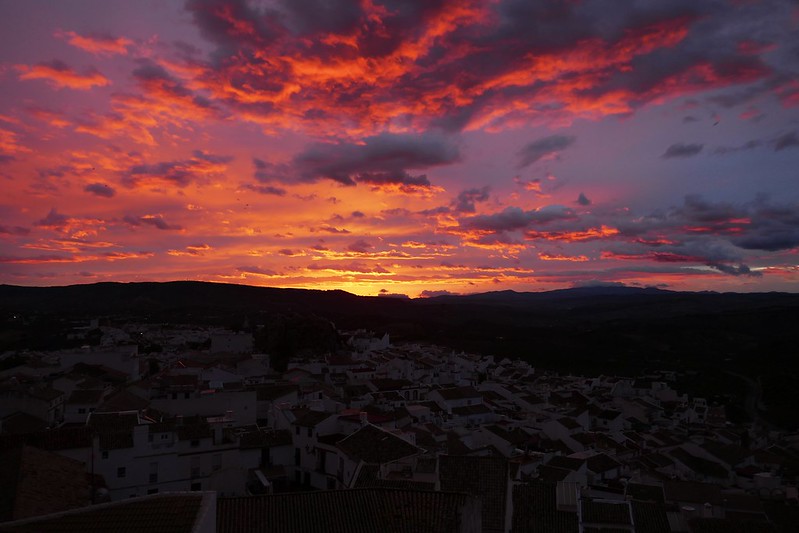
I walk with a heavy heart and some more tears but the camino is therapeutic, even though it’s gloomy and drizzly and I don’t care much for olive groves or griffin vultures today.
The one thing that does resonate with me is that the entire stage unfolds on a 19th-century railway line that’s cut into the mountains. The track was never completely finished but most of the infrastructure for it was built and it remains to this day.
The point is: on the very day when I’m trying to see the light at the end of the tunnel, it’s remarkable and reassuring that the camino takes me through 20 actual tunnels — and that there’s light at the end of all of them.

* Update: the treatment was successful and the danger has passed, for now.
Vía Serrana Day 8 — Coripe to El Coronil: ~28km
There hasn’t been much sunshine — literal or figurative — in the last two days. On the heels of yesterday’s family news, today I find out about the passing of the father of one of my best childhood friends.
All there is for me to do is walk, but there’s no sunshine there, either. It rains on and off in the morning, and it’s foggy and muddy. After Montellano, the mountains are replaced by plains and the camino is on a busy road, both of which render the Vía Serrana unrecognisable. I feel that the best of this camino is behind me now, and that I’m not in the right frame of mind to enjoy whatever’s left.
And then it happens. The sun finally comes out for the first time since Sunday morning, and it warms my bones and my heart. Then, a 14th-century Arab castle appears out of nowhere just off the road just 3km from the end of the stage, and I hasten to it while the sun’s still out.
I climb the crumbling towers, take in the sunshine from atop the ramparts, and, for the briefest of moments, I don’t have a care in the world.

Vía Serrana Day 9 — El Coronil to Utrera: ~19km
Camino arrows are a bit like life: both can be crooked sometimes, but in the end they point you in the right direction.

Today that direction is towards Utrera, the last major stop before Sevilla. It’s a flat, muddy path through brown fields but there’s some sunshine in the morning and I’m happy to be walking. I turn around and see the mountains disappearing in the distance and think about how far I’ve come.
At Los Molares, a construction worker stops me to ask if I’m walking the camino. When I say that I am, he enquires about my stages and distances, we chat for a minute, and his interest brightens my day. He wishes me a buen camino, only the second time anyone has done that on the Vía Serrana.
Utrera feels like a mini-Sevilla and it’s nice to walk through its charming alleyways on the way to my accommodation. It’s gloomy by the time I arrive and rainy later on, but that means I don’t have to be a tourist and instead I can rest ahead of my final day tomorrow. Because from the looks of things, I’ll need it!
Vía Serrana Day 10 — Utrera to Sevilla: ~34km
For the final act of the Vía Serrana today, I’m faced with a 34km stage in the rain. I almost skip it and take a 30-minute train ride from Utrera to Seville instead, because how much fun is it going to be to walk 34km in the rain?
But having fun isn’t why I’m walking this camino anymore. The pilgrimage has been stripped down to its most basic, persevering form: putting one foot in front of the other.
So that’s what I do today. After three hours of off-and-on drizzle in the early morning, biblical rain arrives and there’s nowhere to hide on the open plains, so I get drenched. By the time I reach the outskirts of Alcalá de Guadaira, the streets have become rivers and waterfalls are cascading down staircases.
The rain eventually stops and Sevilla arrives more quickly than I thought, but it takes a long time to make it through the outskirts. Then I’m in the centre and it all comes at once — Plaza de España, the Universidad de Sevilla (where I once attended a paleography colloquium), the Real Alcázar, the cathedral. Suddenly the Giralda is soaring above me, I’m back to where I began, and it’s over.
I don’t know what to feel, but mostly I’m just exhausted. I take the same photo I took before starting out on this camino, yet it’s somehow completely different. It’s dull and gloomy and looks pretty much like the last four days have felt.
But I don’t want that to be my last memory of this camino, so I go back 90 minutes later at nightfall and take the same photo for the third time, with lights and bells and whistles. It’s the brightest one of them all, and that’s how this journey ends.

Thank you for the great and emotional report. I will be making the Via Serrana pilgrimage in March 2025. What I would like to know is where did you stay? Are there Albergues Municipal or Albergues Touristico? Or did you stay in Casa Rual, Hostales or so ?
Best wishes, Volkmar
Thanks Volkmar and buen camino on the Vía Serrana! There are no albergues that I know of, so I stayed in budget hotels, pensiones etc, and paid about €30-45 per night for a single room.
I noticed that you are walking the Via Serrana in March, I will start around 15 th March. How much research have you done?
An exceptional dscription of your journey, Nick. Your podcasts are also a delight. What month did you walk the Via Serrana?
Thank you Jude, too kind! I walked the Vía Serrana in late Nov – early Dec.
Exceptional. Candid. Photography exquisite!
Thank you Nick looking forward to doing the Via Serrana in middle of March 2025. Did you book accommodation on a day to day as some places are rather small
You’re right, most towns only have a couple of accommodation choices. In December it wasn’t busy so I didn’t have problems booking a day or so ahead, but it may be busier in March.
Hi Joseph, my wife and me shall walk the Vía Serrana in March. We fly on March 12th to Malaga and take a bus to La Linea, so that we can start at March 13th. May be, we meet another on our pilgrimage. Buen Camino.
Thank you for brilliant report!
I found a camino sign on a day trip to Ronda, got curious and started looking for more information on it, and this is definitely that.
May have to add it to my list of caminos to be walked in the future!
I recommend it! I would like to walk it again one day. Thank you for visiting and commenting.
Thank you for sharing your journey. I’ll set out myself on this way come the end of January 2025. If by chance you have a list of your chosen accommodations, they would be greatly appreciated. If not, I’ll trust that the Camino will provide.
Hi Thomas, buen camino on the Vía Serrana! Here is my stage and accommodation list (prices for single rooms in Nov-Dec 2022). For Jimena de la Frontera, there was some event on at the time that had booked out the main two hotels, so I had no choice other than the camping, but hopefully you will be luckier.
1. La Linea – San Martín del Tesorillo 27.8 km – Hostel Sabana €40
2. San Martín – Jimena de la Frontera 18.32km Camping Bungalow €45
3. Jimena – El Colmenar 18.42km – Las Buitreras €43
4. El Colmenar – Estación Jimera de Líber 22.83km – Hotel Rural Inz-Almaraz €38
5. Estación Jimera de Líber – Ronda 16.43km – Hotel Morales €30
6. Ronda – Olvera 27.68km – Olvera B&B hostel €35
7. Olvera – Coripe 24.63km – Pension Coripe €30
8. Tue 6-Dec: Coripe – El Coronil 29.52km – Hotel Don Juan €40
9. Wed 7-Dec: El Coronil – Utrera 19.32km – Hotel Veracruz €49
10. Thu 8-Dec: Utrera – Sevilla 34-35km – El Viajero €30
Hi Nick, thank you for your very informative impressions of Via S. Which connection you have used to go to Acinipo? I looked in waymarkedtrails.org and saw that easiest way is to follow the road MA-7402. But, however it seems to be only asphalt… On the other hand the map shows, that there is a path between the Via S. and the MA-7402. You have probably passed this trek when you followed the MA to go back to Via S. Left and right are some buildings. Did you recognize the path? If you followed the MA it enters the Via close to a “Venta Leche” (Milk sale). Did you see there a pass which is leads to CA-9113 and later to Setenil de las Bodegas. I think it could be a good solution to visit both and then stay overnight there. And the next step to Olvera is a reasonable distance. If you have any advice I am happy to hear about it. Thanks again.
Hi Manfred, that’s quite detailed research you have done! If I remember correctly, I took the path turning left off the camino near what is marked as La Parrilla on maps.me (so not the road). I think the last part of this was a bit of an uphill slog without a real path, but it was an adventure at least! Sorry I can’t be more precise.
Thank you Nick, all information helps. I fully understand that you cannot recall all information. In between I asked my Komoot-Route-Planning-Software and I got the right path.
I prepared a screenshot, but I cannot integrate it in this e-mail. Sorry!
Thank you Nick. Your blog is very interesting and informative. My friend Karolien referred it to me and I’m so glad she did. We are in Spain currently and have the opportunity to walk this route in coming weeks. I wanted to ask your opinion on Day 4 – the Canon de las Buitreras. I read elsewhere (I think it was Johnnie Walker’s guide from several years ago) that the first 11km of Day 4 are very tough (steep ascents and steep descents; also some narrow, stoney ledges overlooking the gorge, where care is required) – did you experience this? Or has the route been modified in recent years? I think I read there is a short, narrow tunnel that has to be crawled through and that a backpack could be a hindrance in this tunnel? Do you recall this? We will have backpacks – so I’m just trying to work out how to manage this. Thank you again for your excellent blog.
Hi Patricia, thanks for your message and kind words! I do remember that line in the JW guide and my experience was that it wasn’t nearly as difficult as what he had written, so I wrote this elsewhere in response:
‘This might scare off some people, but I think ‘extremely demanding’ (with extremely underlined) is over the top. Yes, there are ups and downs, but I didn’t find it difficult, and I don’t even have walking poles. The hardest part was having to duck through the tunnel before the bridge at the end of the canyon!’
The tunnel is still manageable though, so I wouldn’t be too concerned. Buen camino on the Vìa Serrana!
Hello Nick Leonard Thank you very much for your description of the route and information of places to stay for the night. It has been very helpful. A friend and I will walk it late march this year. We have time to walk to Olvera, from there we take a bus to Sevilla and stay there for one day. I’m looking forward to walk trough this area who I know a bit, because i lived i Gibraltar for 3 years, 35 years ago.
Greetings from Tone Kirkeby
Thanks and buen camino!
Thank you for this wonderful account of the Serrana – I am a female of 73 and wondered if it was doable for the likes of me –
Hi Marilyn, a bit tough to say as a male of (then) 42, but I think you should be OK! I know a couple of 70-something women who did it last year. The Johnny Walker guide makes the canyon sound extremely difficult, but I (and others) found this to be an exaggeration, so don’t let that put you off. Buen camino!
Hi Marilyn. I am a 74 yr old hiker, maybe a pilgrim. I have just found out about this route and will walk it sometime between nov 26 and march 27. I intend to find a cottage for that time, preferably right on the camino and offer pilgrims my world famous (at least in Muxia and among my grandchildren) cookies. Hope to meet you out there!